

Why Should Anyone Care That You’re Mindful?
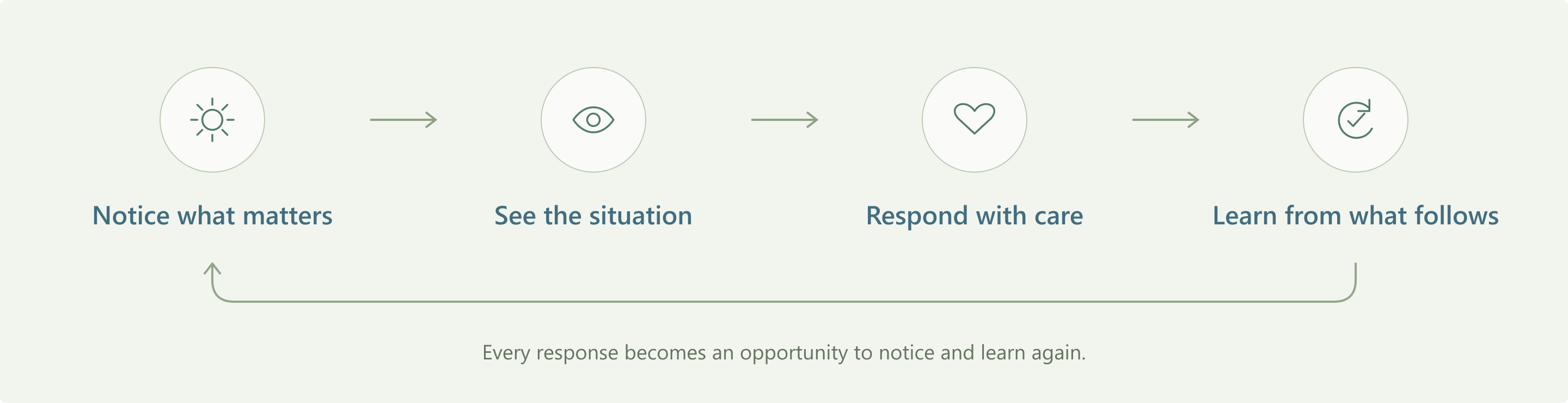
MBEL brings mindfulness into how you see a situation, how you respond, and what your response sets in motion.
Direction
Why ethical mindfulness?
In Buddhist traditions, mindfulness is part of a wider practice concerned with how we live, what we cultivate, how we act, and what the consequences of our actions are.
MBEL places this ethical dimension at the center of what we practice in an experiential way without asking participants to adopt a religious belief system or prescriptive moral code.
MBEL is an invitation to go beyond the usual question:
“What am I experiencing?”
and including:
“What matters here? What is at stake? How will I respond?”
INTERDEPENDENCE
How do you shape a situation that is shaping you?
MBEL includes the world around you as well as yourself.
MBEL widens mindfulness in both directions: toward what is happening within you, and toward the relationships, circumstances, power, history, and possible consequences around you.
You enter every situation with your own history, needs, habits, vulnerabilities, values, and possibilities.
Then you are affected by what is happening and your response helps shape what follows.
Your well-being matters, and decisions you make can influence the wellbeing of others and the world.
THE GAP
Why don’t we always act on what matters to us?
Most of us already know a great deal about how we would like to live.
We want to be patient, yet we answer sharply.
We value honesty, yet we avoid difficult conversation.
We care about other people, yet we may overlook their needs by not considering what our behavior might be doing to them.
We wish to act differently, yet we find ourselves repeating the same actions.
The discrepancies above point to a gap between what matters to us and what we actually do.
MBEL works in that gap.
Pausing to observe ordinary situations in slow motion. This starts to reveal how perception, emotions, body sensations, interpretations, impulses, and habits shape what we do.
With practice, another way of responding ethically can gradually become more available.
EVERYDAY PRACTICE
What do you actually practice?
In MBEL, you practice ethical mindfulness.
Attending to what is at stake in a situation, how responses take shape, and what they may bring about for yourself, for others, and for the wider world.
The training ground is everyday life. In conversations, work, relationships, decisions, conflicts. In moments when you speak, and moments when you don’t.
CARE & RESPONSIBILITY
What guides you when there is no clear answer?
What guides you when there is no clear answer?
MBEL does not prescribe correct answers.
It does not begin with a list of values you are expected to adopt.
And it does not promise that mindfulness will make every difficult situation easy.
Ethical mindfulness does not replace uncertainty with certainty. It cultivates the capacity to respond responsibly in the face of uncertainty.
However, MBEL is not ethically neutral.
It acknowledges vulnerability and points towards less harm, greater care and responsibility, and pays closer attention to the consequences of our actions.
It trains a capacity to see more clearly what is happening, to recognize what may be at stake and to respond with greater awareness of what your actions may leave behind.
Ethics becomes something you practice and experiment with, cultivating a sense of openness and perhaps even joy.

THE COURSE
MBEL COURSE
Nine live sessions
Everyday life as the training ground
Each session begins with your own experience. What you discover during the week becomes material for the next session.
AT A GLANCE
Format: Online via Zoom with online-course material and discussion platform
Schedule: One introductory session plus eight weekly sessions, two hours each
Between sessions: A short daily guided practice, plus brief practice and reflection in ordinary situations
Language: English or German
Teachers: Ayda Duroux, Ulla König, Atabey Sanchez-Haiman, Jochen Weber, Heea Yang
More about the teachers >Fee: 240 / 120 €
Prior experience: Some experience with mindfulness practice is expected — for example, a mindfulness course such as MBSR or a period of personal mindfulness practice. No previous study of ethics is required. This is not a meditation course.